A business photography client portal should give marketing, communications, HR, or PR contacts one clear place to review the prepared assignment after the shoot. The practical result is a branded website handoff where corporate contacts can view, select, discuss, download, or buy the configured work without searching across email threads. Start with one real project, prepare only the material the audience should see, and define the action that should happen after viewing. GalleryDock provides the client-facing gallery, contextual selection and feedback, downloads, and—when configured—digital sales and physical print sales. The website owner chooses where the generated embed is placed and remains responsible for the surrounding page, access decisions, third-party platform settings, permissions, and testing. Check the published experience on desktop and mobile rather than assuming that an editor preview proves the public result. This is a photography client portal, not a CRM, HR portal, employee account system, asset management suite, or legally binding approval service.
Prepare
Define the job before building business photography client portal
An embed is the presentation layer of a client workflow. The gallery, audience, permissions, destination page, and intended next action should be clear before any code is placed.
01
Choose one real audience and outcome
A business photography client portal should give marketing, communications, HR, or PR contacts one clear place to review the prepared assignment after the shoot. Write down who opens the page, what they need to understand, and whether the next step is selection, feedback, download, a digital purchase, a physical print purchase, or a separate business action.
02
Prepare the gallery before embedding
Review image order, names, visible controls, download permissions, optional password access, products, prices, and crops. The embedded version should expose only the choices that belong to this client or public use case.
03
Select a stable destination page
Use the intended published page or template and confirm that the editor allows the required HTML or embed element. Keep a clear owner for later page and gallery updates.
04
Set a practical width and context
Give the gallery enough horizontal space, keep surrounding copy concise, and avoid competing controls immediately beside it. The website should explain why the gallery is present and what visitors should do next.
Embed
Place the gallery with a controlled handoff
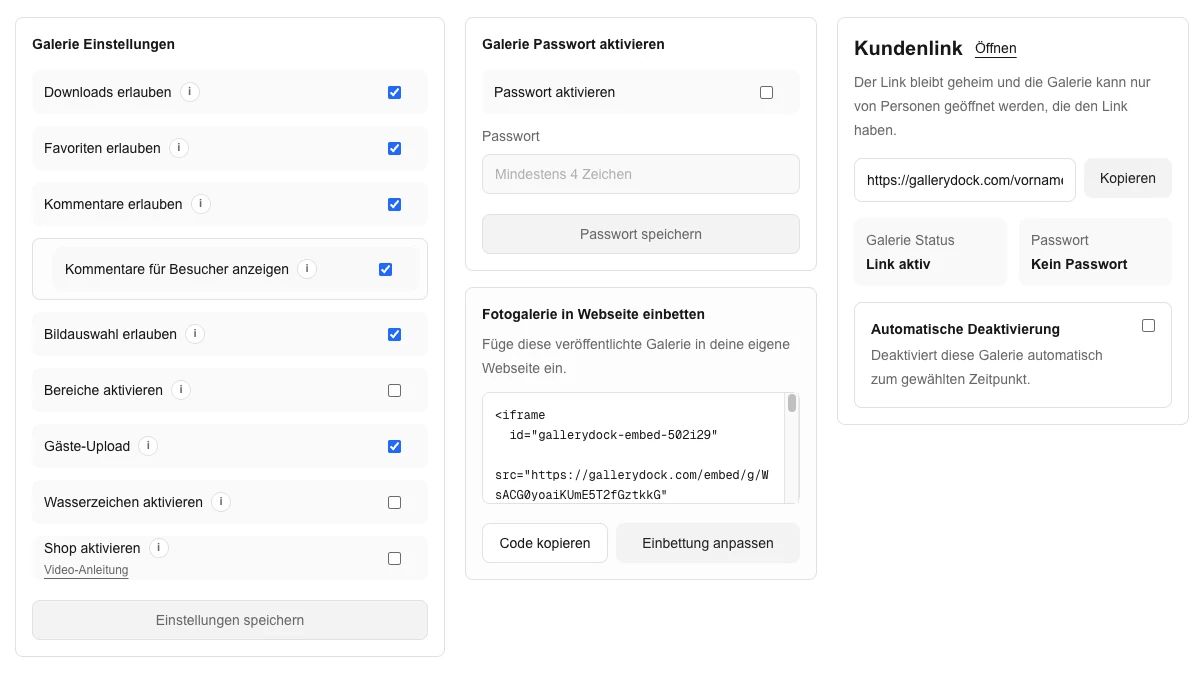
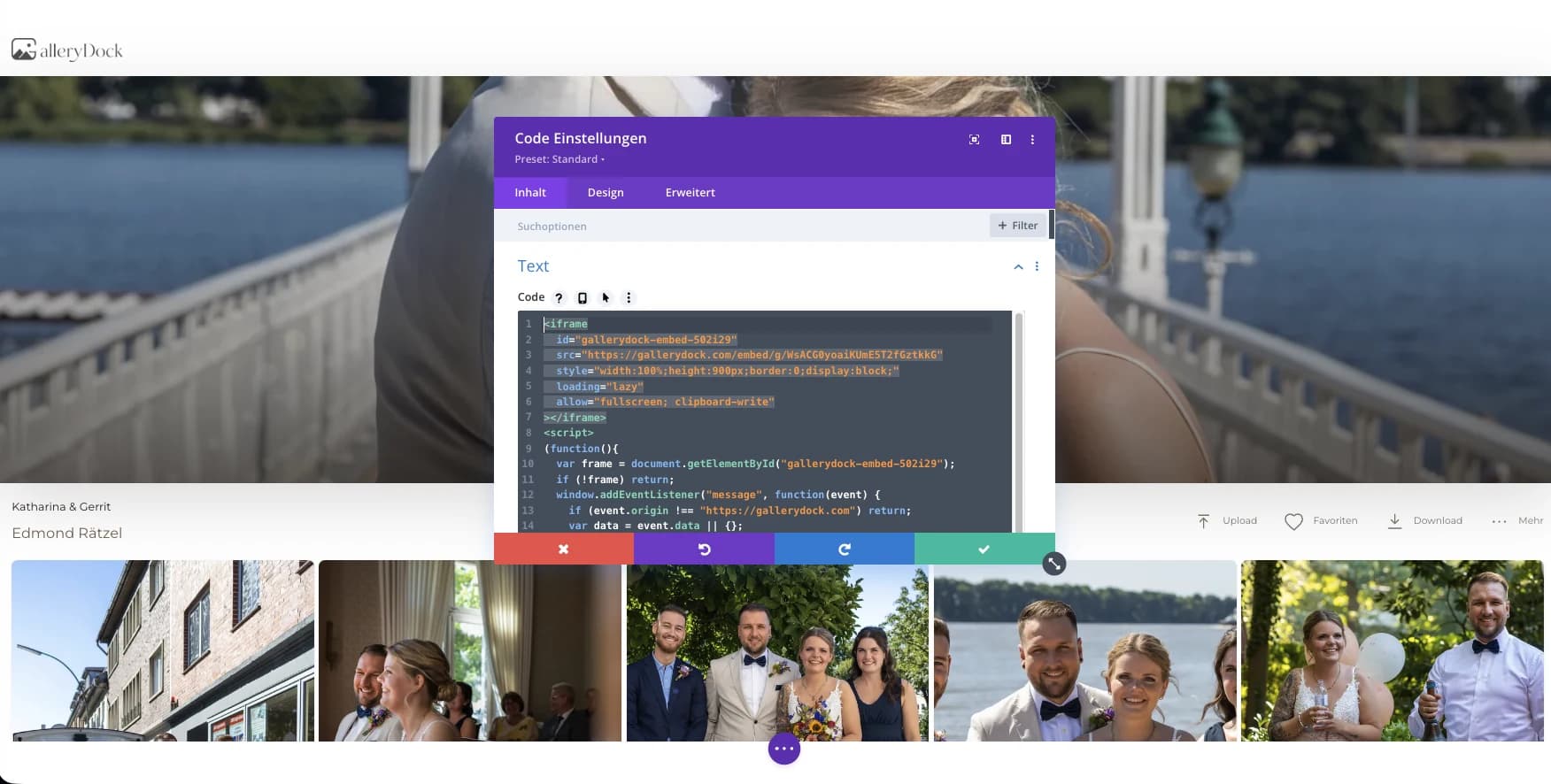
Copy the GalleryDock embed code and place it in the website section reserved for the project or client handoff. Work from the generated code and the destination system's documented content area instead of inventing a parallel integration.
01
Preview the public gallery first
Open the GalleryDock view without owner authentication. Check that the gallery itself is ready before troubleshooting the page builder, CMS, or website layout.
02
Copy the generated embed code
Use the current code from the prepared gallery and keep it intact. Avoid adding undocumented scripts, third-party wrappers, or copied platform assets that create another maintenance surface.
03
Place it in the intended content element
Copy the GalleryDock embed code and place it in the website section reserved for the project or client handoff. Save or publish through the normal website workflow, then inspect the real page rather than relying only on an editor canvas.
04
Keep the client path understandable
The target is a branded website handoff where corporate contacts can view, select, discuss, download, or buy the configured work without searching across email threads. Make selection, feedback, downloads, digital products, physical print products, and external business actions visibly distinct so one control is not mistaken for another.
Verify
Test the published result and its boundaries
Test the portal as a signed-out corporate contact and confirm that confidential and public responsibilities remain clear. A working code paste is only one part of the evidence; the client-facing flow must remain usable and product-truthful.
01
Check desktop and mobile
Verify readable text, usable controls, stable media, correct maximum width, and no horizontal overflow at the actual live URL. Test the same access state a client or visitor receives.
02
Exercise every enabled action
Open images, submit a representative selection or comment where appropriate, verify downloads, inspect configured products and crops, and follow checkout only to the external handoff without completing a purchase.
03
Separate product facts from platform behavior
This is a photography client portal, not a CRM, HR portal, employee account system, asset management suite, or legally binding approval service. Describe only the tested workflow and do not turn an embed, permission, cache, or layout setting into a guarantee.
04
Document the update owner
Record which GalleryDock gallery feeds the page, where the code lives, who can publish website changes, and how the public result is checked after future updates.
Keep selection and feedback with the imagesKeep selection and feedback with the images is shown with the existing GalleryDock product view from the German source guide.Check the client portal on mobileCheck the client portal on mobile is shown with the existing GalleryDock product view from the German source guide.Prepare the intended downloadsPrepare the intended downloads is shown with the existing GalleryDock product view from the German source guide.Copy the generated embed codeCopy the generated embed code is shown with the existing GalleryDock product view from the German source guide.Place the portal on the business websitePlace the portal on the business website is shown with the existing GalleryDock product view from the German source guide.
Comparison
Choose the right approach for business photography client portal
The strongest method matches the audience and maintenance responsibility instead of forcing every job through the same type of link or website component.
Approach
Best for
Tradeoff
Embedded GalleryDock client gallery
a branded website handoff where corporate contacts can view, select, discuss, download, or buy the configured work without searching across email threads
Requires a tested destination page and deliberate gallery setup
Direct GalleryDock link
A focused handoff without surrounding website content
Does not place the experience inside the business website
Generic cloud folder
Straightforward file storage or transfer
Folder structure does not create a curated client workflow
Native CMS image block
A small editorial image set managed in the website
Updates and client actions remain separate from GalleryDock
Custom website integration
Requirements beyond the generated embed
Adds development, security, testing, and maintenance ownership
Executive portraits
An HR contact selects approved portraits and downloads the prepared files.
Annual report
A communications team reviews image options and keeps comments with the relevant photographs.
Employer branding
A marketing contact views a curated set and orders configured digital files or physical prints.
Frequently asked questions
Questions about this workflow
Can I place a business photography portal on my website?
Yes. You can embed the prepared GalleryDock gallery in an appropriate website content area.
Can clients select and comment on images?
GalleryDock can support image selection and contextual feedback when those actions are configured.
Can the portal offer downloads?
Yes. The photographer controls which prepared files and download options are available.
Can clients buy digital files or physical prints?
Yes. GalleryDock supports both digital sales and physical print sales when products are configured.
Does this replace a CRM or HR portal?
No. It is a photography delivery and client-workflow experience, not a general business system.
Ideal for photographers who regularly deliver client galleries.
Unlimited galleries
200 GB storage
Photos & videos
Image upload: 100 MB
Video upload: 15 GB
Your own shop for digital sales
Sell print products in your shop
Only 10% shop fee per sale
Your own profile in client galleries
Password-protect client galleries
Use your own logo as a watermark
Let clients select images and mark favorites
Control photo and video downloads
Embed galleries on your own website
Hide GalleryDock branding
Use your own logo in galleries
For regular client delivery
Pro
Monthly
29 EUR
EUR 348 billed yearly. plus VAT
For photographers managing many projects, videos and growing storage.
Unlimited galleries
1 TB storage
Photos & videos
Image upload: 100 MB
Video upload: 30 GB
Your own shop for digital sales
Sell print products in your shop
Only 5% shop fee per sale
Your own profile in client galleries
Password-protect client galleries
Use your own logo as a watermark
Let clients select images and mark favorites
Control photo and video downloads
Embed galleries on your own website
Hide GalleryDock branding
Use your own logo in galleries
For regular client delivery
Build a clearer business photography client portal workflow
Prepare one real gallery, place it on the intended page, and test the public result from start to finish. The goal is a branded website handoff where corporate contacts can view, select, discuss, download, or buy the configured work without searching across email threads. GalleryDock supports the gallery and commerce path without replacing website administration, professional judgment, or third-party platform responsibility.